vendredi
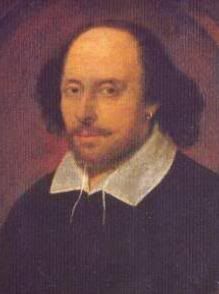
Why Shakespaere had buck teeth
While trying to scan for a verse/line reference from Caliban (for a certain Ethics essay I am obliged to author, in which a comparison between Prospero and the archetype paternalistic doctor is a fortuitous coincidence), I found myself inundated by a deluge of Elizabethan prose.
As I gazed upon a tongue which I had not seen since Sec Four (as opposed to Chinese which has been presumed MIA since J2) a sudden spark of nostalgia dawned upon me. Consider the following extract:
When he himself might his quietus make
With a bare bodkin? who would fardels bear,
To grunt and sweat under a weary life,
But that the dread of something after death,
The undiscover'd country from whose bourn
No traveller returns, puzzles the will
And makes us rather bear those ills we have
Than fly to others that we know not of?
Thus conscience does make cowards of us all;
Memory calls a two sided book - a page of prose and the next of footnotes - and it would be filled with anacronisms such as -
1. quietus: Something that serves to suppress, check, or eliminate, esp. death.
2. fardel: a burden
3. bourn: a small stream or brook, used here to indicate a boundary.
And for every volume of Shakespeare I would faithfully scan every margin, every list of old words - each one an epitaph, a memorial, a lexicon's graveyard. For words die too as surely as the men who utter them, for each one a mortal span where slowly but surely their own quietus made.
Another quirk of Elizabethan prose. Consider the following extract from a contemporary, the King James Bible:
For he saith to Moses, the Lord hath mercy on whom the Lord will have mercy, and He hath compassion on whom He will have compassion. (KJV: Romans)
is perfectly capable of meaning rendered "modern" by the simple substitution of "s" for the consonant "th", as below:
For he sais (says) to Moses, the Lord has mercy on whom the Lord will have mercy, and He has compassion on whom He will have compassion. (KJV: Romans)
Now the "th" for "s" substitution is a familiar one - one that Orthodontic Linguistics terms "incisor speech", colloquially known as a lisp.
Thimple Thimon thinketh that Thakestheare doth require braceth.
While trying to scan for a verse/line reference from Caliban (for a certain Ethics essay I am obliged to author, in which a comparison between Prospero and the archetype paternalistic doctor is a fortuitous coincidence), I found myself inundated by a deluge of Elizabethan prose.
As I gazed upon a tongue which I had not seen since Sec Four (as opposed to Chinese which has been presumed MIA since J2) a sudden spark of nostalgia dawned upon me. Consider the following extract:
When he himself might his quietus make
With a bare bodkin? who would fardels bear,
To grunt and sweat under a weary life,
But that the dread of something after death,
The undiscover'd country from whose bourn
No traveller returns, puzzles the will
And makes us rather bear those ills we have
Than fly to others that we know not of?
Thus conscience does make cowards of us all;
Memory calls a two sided book - a page of prose and the next of footnotes - and it would be filled with anacronisms such as -
1. quietus: Something that serves to suppress, check, or eliminate, esp. death.
2. fardel: a burden
3. bourn: a small stream or brook, used here to indicate a boundary.
And for every volume of Shakespeare I would faithfully scan every margin, every list of old words - each one an epitaph, a memorial, a lexicon's graveyard. For words die too as surely as the men who utter them, for each one a mortal span where slowly but surely their own quietus made.
Another quirk of Elizabethan prose. Consider the following extract from a contemporary, the King James Bible:
For he saith to Moses, the Lord hath mercy on whom the Lord will have mercy, and He hath compassion on whom He will have compassion. (KJV: Romans)
is perfectly capable of meaning rendered "modern" by the simple substitution of "s" for the consonant "th", as below:
For he sais (says) to Moses, the Lord has mercy on whom the Lord will have mercy, and He has compassion on whom He will have compassion. (KJV: Romans)
Now the "th" for "s" substitution is a familiar one - one that Orthodontic Linguistics terms "incisor speech", colloquially known as a lisp.
Thimple Thimon thinketh that Thakestheare doth require braceth.
posted by anodyne @ 8.7.05

